


Whether filing as a small business entity, individually, as a single filer, or jointly with a spouse, the core challenges remain the same.
Stop settling for uncertainty. Secure your spot and experience revolutionary tax strategies designed to maximize your returns.
Organizing your paperwork by category helps ensure you don't miss valuable credits or trigger IRS notices from forgotten forms.
Personal & Household Information
• Identification: Social Security numbers (SSNs) or ITINs, plus birthdates, for you, your spouse, and all dependents.
• Prior Year Return: A copy of last year's federal and state tax returns (helpful for Adjusted Gross Income verification and carryovers).
• Banking Details: Routing and account numbers for direct deposit or electronic payment.
• Life Changes: Records of marriage, divorce, births, adoptions, or a death in the family during the tax year.
• IRS Notices: Any letters received from the IRS or state tax agencies, including Identity Protection PINs (IP PIN).
Tax Credits & Other Payments
• Child & Dependent Care: Provider's name, address, Tax ID (EIN or SSN), and total amount paid for daycare or after-school care.
• Higher Education: Form 1098-T (tuition statement) and receipts for required course materials.
• Clean Energy & EVs: Invoices and manufacturer certifications for energy-efficient home upgrades (solar, heat pumps, windows) or electric vehicle purchases.
• Health Insurance: Form 1095-A if you purchased coverage through the Health Insurance Marketplace.
• Estimated Taxes: Dates and amounts of any quarterly federal or state estimated tax payments made during the year.
Income Documents
• Employment: Form W-2 from all employers.
• Self-Employment & Gig Work: Forms 1099-NEC (nonemployee compensation) and 1099-K (payment cards and third-party networks like PayPal, Venmo, or eBay).
• Investments & Banking:
• 1099-INT (bank interest)
• 1099-DIV (dividends and distributions)
• 1099-B (sales of stocks, bonds, mutual funds, or cryptocurrency)
• Retirement & Social Security:
• 1099-R (distributions from pensions, annuities, IRAs, or 401(k)s)
• SSA-1099 (Social Security benefits)
• Other Income:
• 1099-G (unemployment compensation or state/local tax refunds)
• W-2G (gambling winnings)
• Schedule K-1 (income from partnerships, S-corporations, estates, or trusts)
• Rental property income records, alimony received (for pre-2019 agreements), or jury duty pay.
Above-the-Line Adjustments (No Itemizing Required)
• Retirement Contributions: Records of Traditional IRA, SEP, or SIMPLE IRA contributions (Form 5498).
• Health Savings: Form 1099-SA (distributions) and Form 5498-SA (contributions) for Health Savings Accounts (HSAs).
• Education: Form 1098-E for student loan interest paid.
• Educators: Receipts for classroom supplies purchased by K–12 teachers.
• Self-Employed Expenses: Health insurance premiums paid while self-employed.
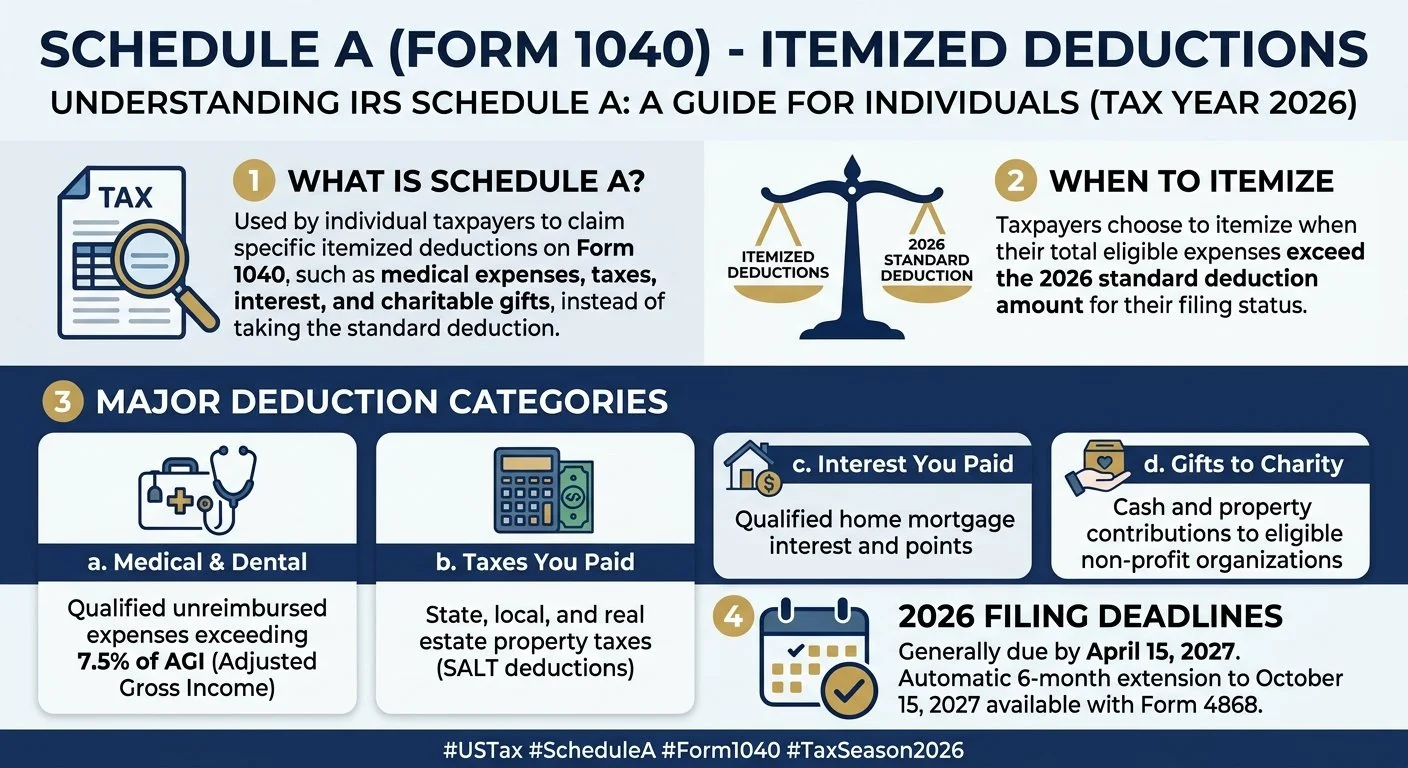
Itemized Deductions (Schedule A)
Note: Only beneficial if your total itemized expenses exceed the standard deduction for your filing status.
• Homeownership: Form 1098 showing mortgage interest and points paid.
• Taxes Paid: Receipts for state and local income taxes, real estate property taxes, and personal property taxes (such as vehicle registration fees).
• Charitable Giving: Written acknowledgments for cash donations and receipts/valuations for donated goods.
• Medical & Dental: Out-of-pocket expenses for doctors, prescriptions, glasses, and medical mileage (only deductible if they exceed 7.5% of your Adjusted Gross Income).
For tax year 2026 (filed in early 2027), several new rules under the One Big Beautiful Bill Act (OBBBA) directly impact itemized deductions on Schedule A—including a higher SALT cap, a new 0.5% floor on charitable donations, the return of the PMI deduction, and an overall deduction cap for top-bracket earners.
Itemizing only lowers your tax bill if your total Schedule A deductions exceed the 2026 standard deduction: $16,100 (Single/Married Filing Separately), $24,150 (Head of Household), or $32,200 (Married Filing Jointly).
Use this tailored checklist to gather your Schedule A documents and capture every deduction available for 2026.

State and Local Taxes (SALT) — Cap Raised to $40,400
For 2026, the maximum SALT deduction is $40,400 ($20,200 if married filing separately), though it phases down toward $10,000 once your Modified Adjusted Gross Income (MAGI) exceeds $505,000 ($252,500 MFS). Gather records for:
• State & Local Income Taxes: State/local tax withholdings shown on Form W-2 or 1099-R, plus receipts for any 2026 state/local estimated tax payments made during the year (including Q4 2025 state estimates paid in January 2026).
• State & Local Sales Taxes (Alternative): If you live in a state without income tax or had major purchases, gather receipts for big-ticket items (vehicles, boats, aircraft, home building materials) to compare general sales tax against income tax.
• Real Estate Property Taxes: Annual property tax statements or Form 1098 escrow summaries for your primary home, vacation home, or land.
• Personal Property Taxes: Annual vehicle, boat, or RV registration bills showing the portion of the fee based strictly on the value of the property.
Other 2026 Schedule A & Related Deductions
• Gambling Losses (New 2026 Cap): Win/loss statements, wagering tickets, and diary logs—for 2026, gambling losses are capped at 90% of your losses and cannot exceed your reported gambling winnings.
• Investment Interest Expense: Form 1099-B or brokerage margin statements showing interest paid on money borrowed to buy taxable investments (deductible up to net investment income).
• Educator Expenses Above $350: For 2026, K–12 teachers can deduct up to $350 above-the-line ($700 if married filing jointly and both are educators), and any unreimbursed educator expenses above $350 now qualify as an itemized deduction on Schedule A.
• Federally Declared Disaster Losses: FEMA disaster declaration numbers, insurance claim payouts, and repair/appraisal records for casualty losses in a federally declared disaster area.
• High-Income Overall Limitation (37% Bracket): If your taxable income puts you in the top 37% marginal bracket (over $640,600 single or $768,600 joint), your total itemized deductions will be reduced by 2/37ths.
Home Mortgage Interest & PMI — PMI Returns for 2026
• Mortgage Interest (Form 1098): Interest paid on up to $750,000 of qualified acquisition debt ($375,000 if married filing separately) used to buy, build, or substantially improve your primary or second home.
• Home Equity Debt: Interest on HELOCs or home equity loans only if you have receipts proving the funds were used to buy, build, or substantially improve the home securing the loan.
• Mortgage Points: Closing disclosures (ALTA/CD) from a 2026 home purchase or refinance showing discount points paid.
• Private Mortgage Insurance (PMI): Starting in 2026, qualified mortgage insurance premiums (PMI, FHA MIP, VA funding fees) are once again deductible on Schedule A—check Box 5 of Form 1098.
Charitable Contributions — New 0.5% AGI Floor
Starting in 2026, itemizers can only deduct total charitable contributions that exceed 0.5% of their Adjusted Gross Income (AGI). Gather:
• Cash, Check & Card Donations: Bank statements, credit card records, or payroll deduction stubs (e.g., United Way) showing the date and amount.
• Written Acknowledgments: Official receipts from 501(c)(3) charities for any single donation of $250 or more stating no goods or services were received in exchange.
• Non-Cash Donations: Itemized thrift-store receipts (Goodwill, Salvation Army) with fair-market valuations; Form 1098-C for donated vehicles; and Form 8283 (plus a qualified appraisal) if total non-cash donations exceed $500 (or $5,000 for appraisals).
• Donated Appreciated Stock: Brokerage confirmations showing the date of transfer and fair market value on the gift date.
• Charitable Mileage: Logs of miles driven strictly for volunteer service (deductible at 14 cents per mile) plus parking and tolls.
Don't Forget: 2026 Deductions Available On Top of Itemizing
You can claim these separate deductions even when you itemize on Schedule A:
• Qualified Overtime & Tips: W-2 or 1099 records breaking out qualified overtime premium pay (up to $12,500 single / $25,000 joint) and qualified tip income (up to $25,000), subject to income phaseouts.
• U.S.-Assembled Auto Loan Interest: Lender statements showing up to $10,000 in interest paid on a new personal vehicle assembled in the U.S. (subject to income phaseouts).
• Senior Deduction (Age 65+): Up to $6,000 per qualifying individual age 65 or older (phases out starting at $75,000 MAGI single / $150,000 joint).
Medical & Dental Expenses — 7.5% AGI Floor
Only out-of-pocket expenses that exceed 7.5% of your AGI are deductible (do not include costs reimbursed by insurance or paid via an HSA/FSA):
• Insurance Premiums: Out-of-pocket medical, dental, vision, and Medicare Part B/D premiums paid with after-tax dollars, plus age-capped qualified long-term care insurance premiums.
• Medical Care & Prescriptions: Receipts for doctor/specialist copays, hospital stays, surgery, dental work, prescription drugs, and insulin.
• Medical Equipment & Supplies: Invoices for eyeglasses, contact lenses, hearing aids, crutches, wheelchairs, and diagnostic devices.
• Medical Travel: Mileage logs for trips to medical appointments/pharmacies, plus lodging (up to $50/night) for out-of-town medical care.